
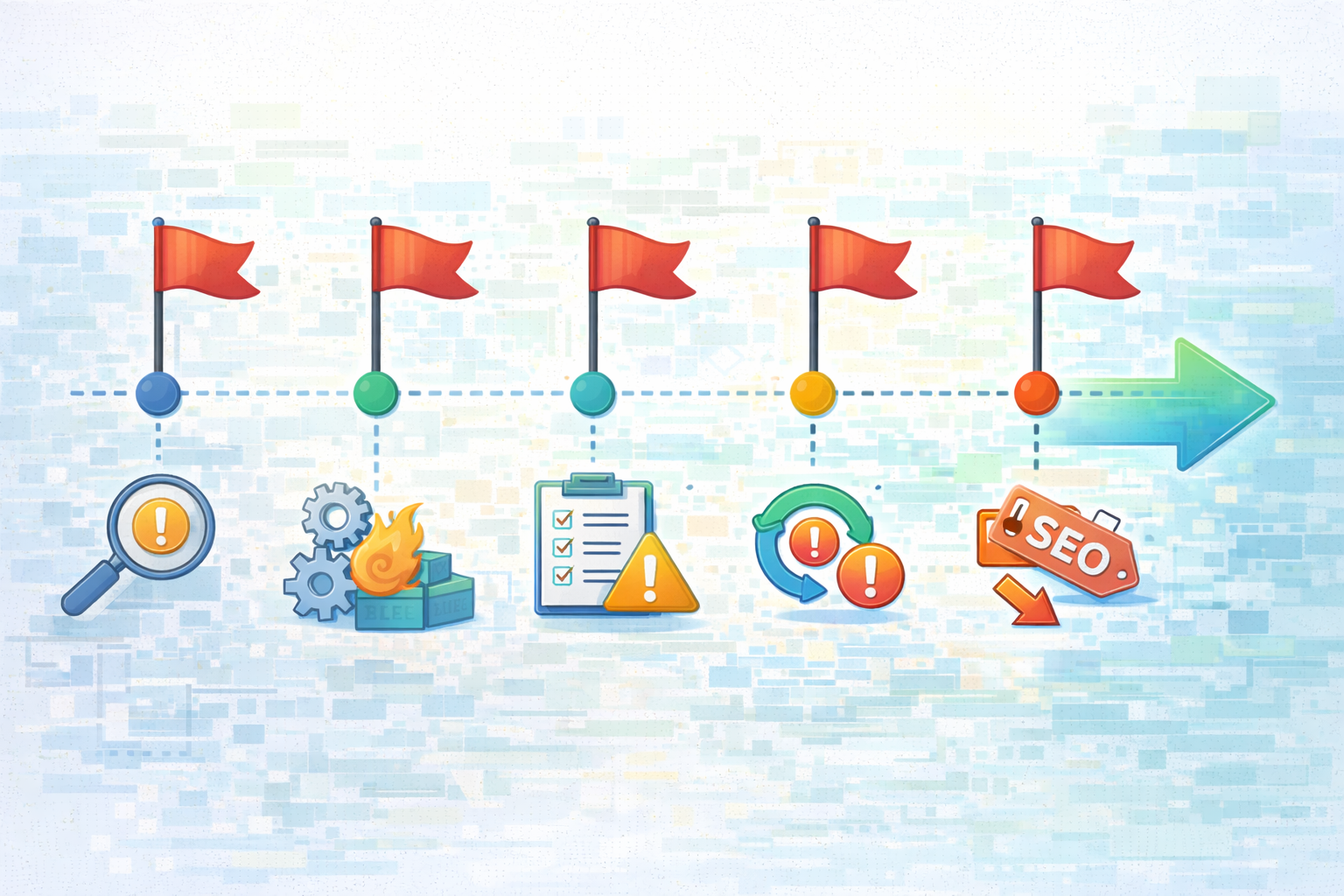
Most migration problems do not appear suddenly. They build up gradually while everyone assumes things are fine.
Then you go live and discover orders are not processing properly. Or SEO has collapsed. Or customer data is wrong.
By then the damage is done.
Here are the warning signs that your migration is going wrong, and what to do about them before it is too late.
Red Flag 1: No Proper Discovery
Your migration starts with someone saying "we can definitely do that" before they have actually looked at your store properly.
They quote you a price over email. Give you a timeline based on nothing. Start work immediately.
This is how migrations go wrong.
Why this matters:
Every store is different. What looks simple from the outside is often complicated once you look at the data and features properly.
Without discovery, the agency does not know what they are dealing with. They make assumptions. Those assumptions are wrong. The project goes over budget and over time.
What should happen:
Discovery first. Someone should look at your current platform, review your data, understand your features, list your integrations, and assess the risks.
Only then should they give you a timeline and cost.
What to do if this is missing:
Stop. Do proper discovery before going any further. It is not too late.
Red Flag 2: Everything is in the Main Project
Your agency gives you a single estimate covering everything. Migration, redesign, new features, SEO work, custom development, training.
All bundled together. One price. One timeline.
This is a recipe for disaster.
Why this matters:
Migration is risky enough on its own. Adding redesign and new features at the same time multiplies the risk.
You cannot test the migration properly if the design is also changing. You cannot isolate problems if everything is happening at once.
And when things go wrong (they will), you cannot tell whether it is a migration problem or a design problem or a new feature problem.
What should happen:
Migrate first. Get the new platform working with the current design and features. Test thoroughly. Go live.
Then improve things. Redesign. Add features. Optimise.
What to do if this is happening:
Split the project. Migration first. Everything else later.
Red Flag 3: Testing is Left Until the End
Your migration project plan has weeks of development work and a few days of testing at the end.
Testing is treated as a checkbox. Something to do quickly before launch.
This is how broken checkouts, failed payments, and data problems slip through.
Why this matters:
Testing needs to happen throughout the project, not just at the end.
Test data migration early. Test each feature as it is built. Test integrations as soon as they are configured.
If you leave testing until the end, you discover problems when there is no time to fix them properly. You either rush fixes or delay launch.
What should happen:
Testing happens continuously. Data migration is tested early and often. Features are tested as they are built. Integrations are tested as soon as they are configured.
Final testing before launch is confirmation that everything still works, not discovery of new problems.
What to do if this is happening:
Insist on iterative testing. Test early. Test often. Do not wait until the end.
Red Flag 4: No Plan for Parallel Running
Your agency plans to take your store offline for a weekend, migrate everything, and go live on Monday.
This is the fastest way to migrate. It is also the riskiest.
Why this matters:
If something does not work when you go live, you are offline until it is fixed.
If the checkout breaks, you cannot take orders. If payment processing fails, you lose sales. If something critical is wrong, you cannot trade.
And you do not discover these problems until you are live with real customers.
What should happen:
Build and test the new platform while the old one stays live. Only switch when everything is confirmed working.
This costs more but eliminates the risk of downtime.
What to do if this is happening:
Push for parallel running. The extra cost is cheaper than lost sales.
Red Flag 5: SEO is Not Mentioned
You are halfway through the migration and nobody has talked about redirects, URLs, or SEO.
The focus is entirely on getting the new platform working. SEO will be sorted out later.
This is how rankings collapse.
Why this matters:
Every URL on your old platform is indexed by Google. Every product, every category, every page.
When you migrate, all those URLs change. If you do not set up proper redirects, Google loses those pages. Your rankings drop. Organic traffic disappears.
And once rankings drop, they take months to recover.
What should happen:
URL mapping should happen early in the project. Every old URL mapped to its new equivalent. Redirects set up and tested before launch.
SEO should be considered throughout, not bolted on at the end.
What to do if this is happening:
Stop everything. Map URLs now. Set up redirects properly. Test them before launch.
Do not go live until this is done.
Other Warning Signs
These five are the most common. But watch for these too:
- No written plan. Everything is verbal. Nothing is documented.
- Unclear responsibilities. Nobody knows who is doing what.
- No staging environment. Everything is being built directly on the live platform.
- Scope keeps changing. Features keep getting added.
- Communication is vague. Updates lack detail.
- Unrealistic optimism. Everything is fine despite obvious issues.
All of these are signs the migration is not under control.
What To Do If You See These Red Flags
Do not ignore them. Do not assume they will sort themselves out.
Stop and assess. What is actually wrong? What needs to change?
Raise concerns clearly. Talk to the agency. Ask for specific plans to address the problems.
Demand proper planning. Get a detailed project plan. Clear responsibilities. Proper testing schedule.
Consider getting a second opinion. If the agency is defensive or dismissive, get someone else to review the project.
Be prepared to pause. A delayed migration is annoying. A failed migration is disastrous.
What To Do Next
If you are planning a migration, make sure these red flags do not appear in the first place.
Insist on proper discovery. Demand a clear plan. Make sure testing happens throughout. Require parallel running. Get SEO sorted early.
A good agency will do all of this anyway. If they push back, find a better agency.
Need help with your migration? Our Platform Migration Service is designed to avoid all of these problems. Book a discovery call and we will show you how a properly planned migration works.