Everyone wants to know how long a platform migration takes.
The answer you will get from most agencies is "6 to 8 weeks".
The real answer is "it depends, and probably longer than you think".
Here is why timelines slip, what actually affects them, and how to get a realistic estimate.
Why Everyone Says 6 to 8 Weeks
Six to eight weeks sounds reasonable. Not so long that it feels risky. Not so short that it seems rushed.
It is also completely arbitrary.
Some migrations genuinely do take 6 weeks. Simple stores with clean data and straightforward requirements. But most ecommerce businesses are not simple.
They have years of accumulated complexity. Custom features built by developers who left years ago. Data that nobody cleaned up because it was never a priority. Integrations with systems that barely work anymore.
All of that takes time to unpick and rebuild.
What Actually Affects Timeline
Here is what makes migrations take longer:
Data volume. 1,000 products is quick. 50,000 products with variants and custom attributes takes weeks to map and migrate properly.
Data quality. Clean, well-structured data migrates fast. Messy data with missing fields, duplicates, and inconsistencies needs cleaning first.
Custom features. Every custom feature on your old platform needs rebuilding or replacing on the new one. Custom checkout flows, bespoke integrations, unusual product configurations. Each one adds time.
Integrations. ERP systems, warehouse management, email marketing, accounting software. Each integration needs reconfiguring and testing on the new platform.
Team availability. Migrations need input from your team. Product data to review. Checkout flows to test. Training to complete. If your team is busy, the migration waits.
Decision making. Every migration involves decisions. Which products to keep. How to structure categories. What features to rebuild. Slow decisions mean slow migrations.
The Real Phases
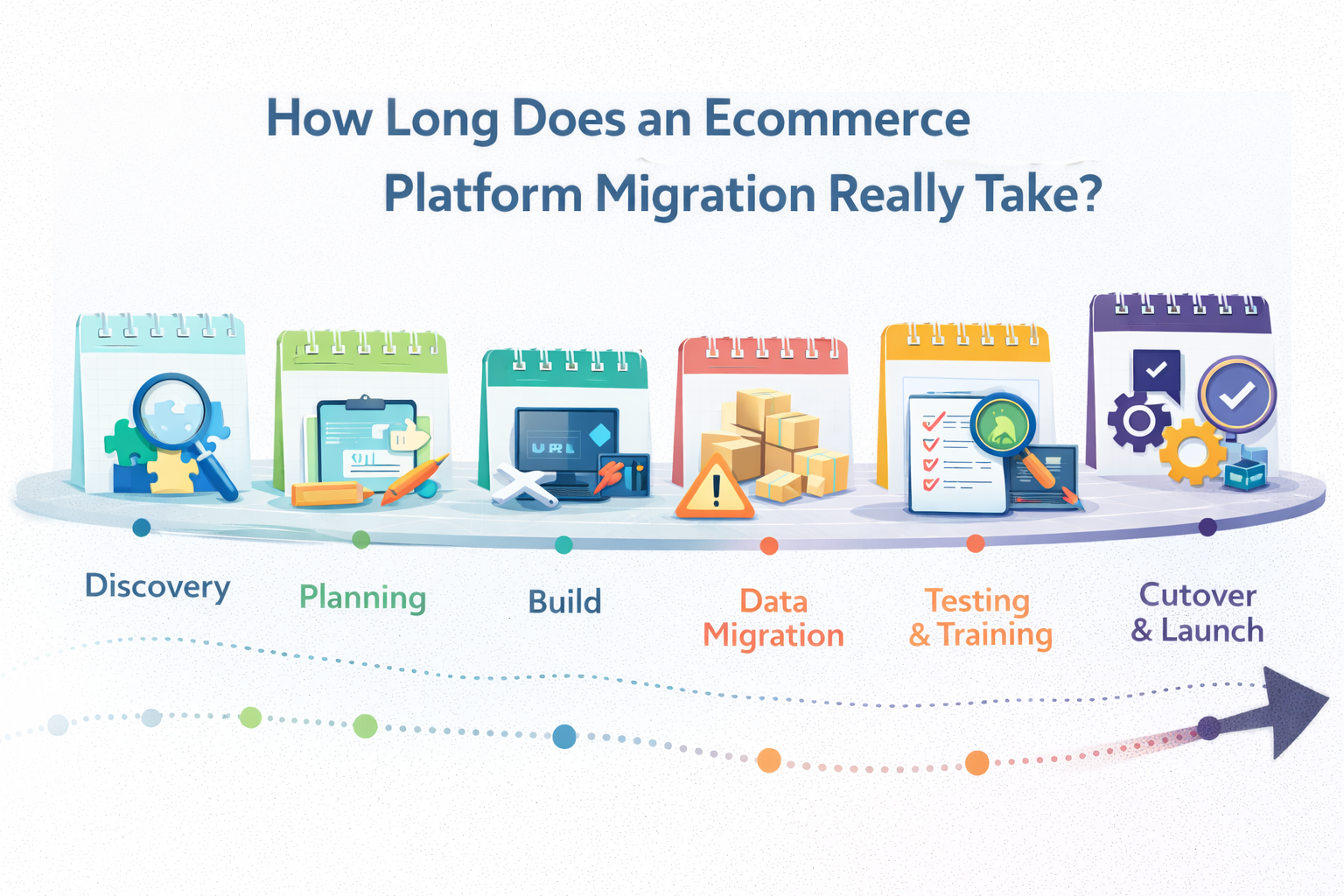
Here is what actually happens during a migration, and how long each phase takes:
Discovery (1–2 weeks)
Audit your current platform. Map out data structure. Identify custom features and integrations. Work out what needs migrating and what can be simplified.
This phase should not be rushed. Get it wrong and everything else goes wrong too.
Planning (1–2 weeks)
Map data fields from old platform to new. Plan URL redirects. Design the migration process. Agree testing criteria. Set a cutover plan.
Again, do not rush this. A good plan saves weeks later.
Build (3–6 weeks)
Set up the new platform. Configure theme and settings. Build any custom features. Set up integrations. Import products and categories.
This is where most of the time goes. And it always takes longer than expected because unexpected problems appear.
Data Migration (1–2 weeks)
Migrate customer data. Import order history. Move any other data (reviews, blog posts, CMS content).
This needs to happen close to launch so the data is not too out of sync with the live site.
Testing (1–2 weeks)
Test everything. Checkout flow, payment processing, email confirmations, stock updates, integrations. Test on different devices and browsers. Fix anything that breaks.
Do not skip this. Most post-launch problems come from inadequate testing.
Training (1 week)
Train your team on the new platform. How to process orders, manage products, run reports, handle customer queries.
Do this before launch, not after.
Cutover (1–2 days)
Switch DNS. Monitor closely. Fix any immediate problems.
This should be boring if everything before was done properly.
Post-Launch Support (2–4 weeks)
Monitor orders, fix edge cases, handle any issues that appear with real traffic. This is essential.
Realistic Timelines
Here are some realistic timelines based on store complexity:
Simple store: 1,000 products, standard checkout, no integrations. 6 to 8 weeks.
Medium complexity: 5,000 to 10,000 products, custom checkout, basic integrations (email, accounting). 10 to 14 weeks.
Complex store: 20,000+ products, multiple integrations, custom features, B2B functionality. 16 to 24 weeks.
Enterprise: Multiple warehouses, international stores, complex ERP integration, custom everything. 6 months or more.
Anyone quoting significantly less than this is either cutting corners or does not understand the scope.
Why Timelines Slip
Even with good planning, migrations run over. Here is why:
Unexpected complexity. You discover features you forgot about. Data is messier than you thought. Integrations work differently than documented.
Scope creep. While migrating, you decide to rebuild parts of the site. Add new features. Redesign sections. All of this adds time.
External dependencies. Waiting for API access from third parties. Waiting for team input. Waiting for decisions from stakeholders.
Testing reveals problems. Something that looked fine in development breaks under load. Edge cases appear that nobody anticipated.
Seasonal constraints. You cannot launch during peak trading. So the migration waits until after Christmas, or Black Friday, or whatever your busy period is.
All of this is normal. Budget for it.
How To Get a Realistic Timeline
Do not accept a timeline until someone has properly assessed your store.
They need to look at your data. Understand your custom features. Review your integrations. Talk to your team about requirements.
Only then can they give you a realistic estimate.
And even then, add a buffer. Things always take longer than expected.
What To Do Next
If you are planning a migration, start with a proper discovery phase. Get someone to assess your current setup and give you a realistic timeline and cost.
Do not commit to anything until you have a clear plan and understand what is involved.
Need help with your migration? Our Platform Migration Service starts with a thorough discovery phase so you know exactly what to expect. Book a call and we will give you an honest timeline.