At a glance
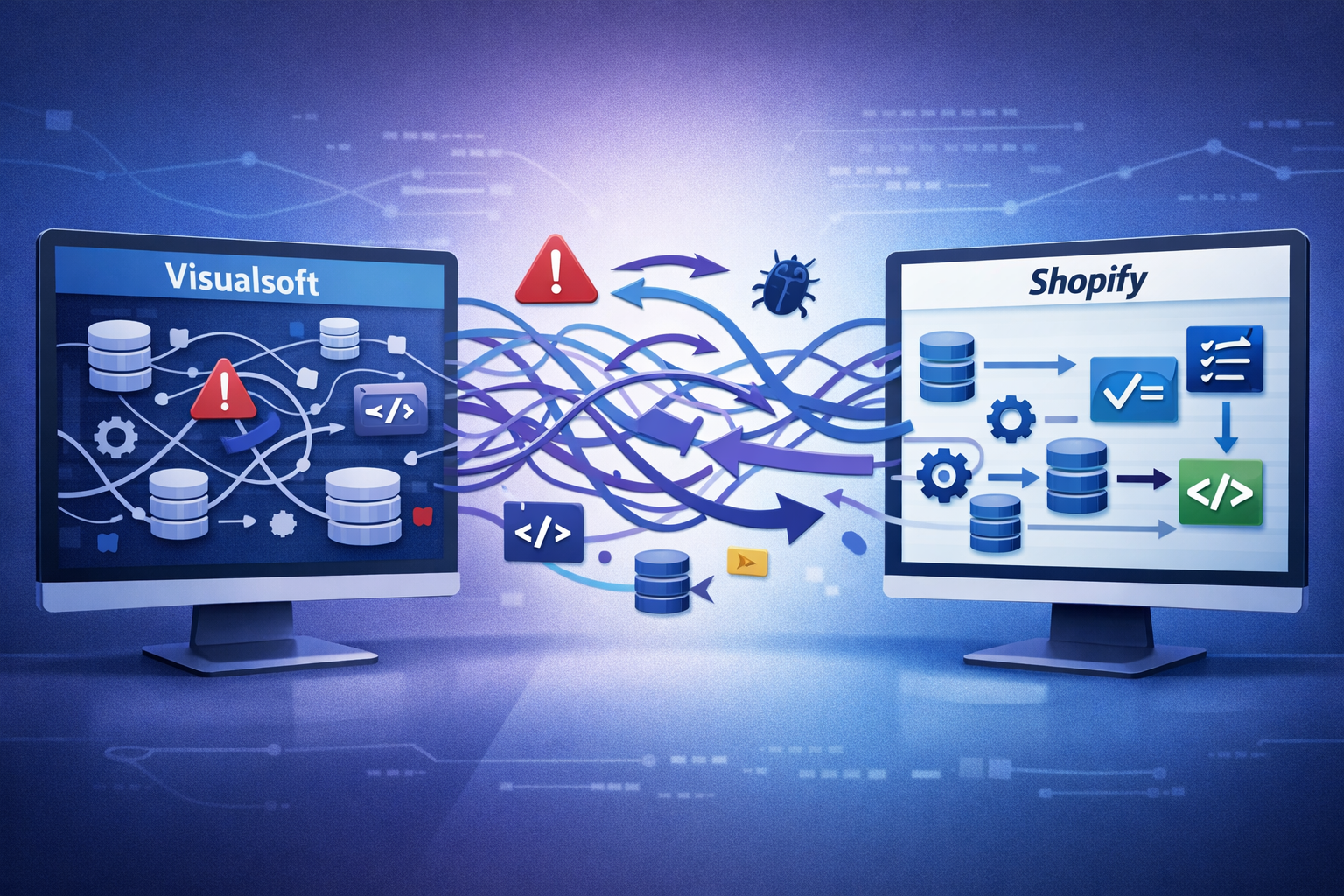
Visualsoft to Shopify migrations involve specific technical challenges that generic migration tools can't handle. Most agencies underestimate the complexity because they haven't worked with Visualsoft's data architecture, custom functionality, and URL structures before. This guide covers what actually goes wrong and why specialist knowledge matters.
The data architecture problem
Visualsoft stores product data differently from most ecommerce platforms. Where Shopify uses a straightforward product-variant model, Visualsoft's database structure includes custom tables for product specifications, complex attribute hierarchies, and proprietary field types that don't map cleanly to Shopify's metafield system.
The most common issue we see is agencies attempting to migrate this data using standard CSV imports or basic migration tools. They'll successfully transfer product names, prices, and descriptions, but lose the detailed specifications, custom attributes, and variant relationships that make the difference between a functional store and one that actually serves customers properly.
What gets lost in basic migrations:
- Custom product specifications — Visualsoft's spec tables don't translate to standard Shopify product fields
- Complex variant structures — Multi-dimensional variants (size, colour, material) often collapse into single options
- Category hierarchies — Visualsoft's nested category system requires manual collection mapping in Shopify
- Custom field relationships — Dependencies between fields that control product display and functionality
Custom functionality gaps
Visualsoft retailers often rely on platform-specific functionality that has no direct Shopify equivalent. Trade pricing systems, bulk order forms, custom product configurators, and integrated inventory management features all need to be rebuilt rather than migrated.
Generic agencies typically discover these gaps late in the process, leading to scope creep and delayed launches. The conversation shifts from "migrating your store" to "rebuilding significant chunks of your business logic" — a different project entirely.
Common Visualsoft features requiring custom rebuilding:
| Visualsoft Feature | Shopify Approach | Complexity |
|---|---|---|
| Trade pricing tiers | Custom app or Shopify Plus pricing scripts | Medium |
| Bulk order forms | Custom theme development + cart API | High |
| Product configurators | Custom app development | High |
| Integrated inventory sync | Third-party app + custom integration | Medium |
SEO structure challenges
Visualsoft's URL structure follows patterns that don't align with Shopify's default approach. Product URLs, category pages, and content structures need careful mapping to preserve search rankings during migration.
The critical issue is that Visualsoft sites often have years of SEO equity built into specific URL patterns. A poorly planned migration can wipe out organic traffic overnight. Yet most migration tools focus on moving products and orders, treating URL preservation as an afterthought.
URL structure risks:
- Product URL patterns — Visualsoft's /product-name-id format vs Shopify's /products/product-name
- Category structures — Multi-level category URLs that need collection mapping
- Search-friendly URLs — Custom URL rules that don't transfer automatically
- Content page mapping — CMS content with established search rankings
Bottom line: Without proper 301 redirect mapping, you can lose months or years of SEO work in a single migration.
Why generic tools fall short
Most migration services are built for common platform combinations — Magento to Shopify, WooCommerce to Shopify, BigCommerce to Shopify. Visualsoft's UK market focus and specific architecture mean it's not covered by standard migration tools.
The result is that agencies either attempt manual CSV exports (losing data integrity) or try to force Visualsoft data through tools designed for other platforms (creating mapping errors). Both approaches create problems that only surface after go-live, when it's too late to fix them without significant downtime.
What actually goes wrong
Based on our experience with Visualsoft migrations, the most common issues we see from poorly executed projects are:
- Product variants collapse — Complex size/colour/material combinations get flattened into single variants, making inventory management impossible
- Specifications disappear — Detailed product specs that customers rely on for purchasing decisions don't transfer
- SEO rankings drop — Poor URL mapping causes search traffic to plummet in the months following launch
- Custom functionality breaks — Trade accounts, bulk ordering, and configurators stop working, forcing rushed rebuilds
- Data integrity issues — Pricing, inventory levels, and customer data contain errors that compound over time
The pattern we see repeatedly is agencies quoting based on a standard Shopify migration, then discovering Visualsoft's specific requirements mid-project. The result is scope creep, delayed timelines, and compromised functionality.
The specialist difference
Successful Visualsoft to Shopify migrations require understanding both platforms intimately. This is exactly the complexity our migration process is designed around — details in our full Visualsoft migration guide.
The key differentiators are:
- Data mapping expertise — Understanding how Visualsoft's data structure translates to Shopify's model
- Custom functionality planning — Identifying what needs rebuilding before migration starts, not after
- SEO preservation strategy — Proper URL mapping and redirect implementation from day one
- Post-migration testing — Comprehensive validation of data integrity, functionality, and performance
Key takeaways
- Visualsoft migrations are more complex than standard ecommerce platform switches
- Generic migration tools don't handle Visualsoft's specific data architecture
- Custom functionality often needs rebuilding, not just migrating
- SEO preservation requires careful URL mapping and redirect planning
- Choose an agency with proven Visualsoft migration experience
Considering a migration from Visualsoft to Shopify? We've completed multiple Visualsoft migrations and understand the technical challenges involved. Get in touch to discuss your specific requirements.